
 English
 Hindi
Hindi Arabic
 Bengali
 Chinese
 French
 German
 Italian
 Japanese
 Korean
 Russian
 Spanish
 Thai
Thai Vietnamese
Because liquid sugar hits differently — even when it comes from fruit
Juice feels like a healthy choice. It’s “natural,” it comes from fruit, and it tastes fresh.
But metabolically, drinking fruit is not the same as eating fruit.
Whole Fruit vs Juice: The Missing Fiber
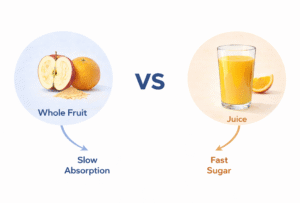
Whole fruit contains fiber, which slows absorption and helps you feel full.
When fruit becomes juice, much of the fiber is removed — leaving a beverage that is easy to
drink quickly and easy to overconsume.
That’s why many people can drink one glass of juice in seconds — even though it may
represent the sugar content of multiple pieces of fruit.
Fructose: Less Insulin Spike, More Liver Work
Fruit sugar contains fructose, and fructose generally stimulates insulin less than glucose.
But here’s the key point: most juices contain both fructose and glucose, and because juice is
low in fiber, it can still raise blood sugar and insulin — especially when consumed alone.
What makes fructose unique is where it goes:
fructose is largely processed in the liver.
Why Too Much Juice Can Raise Triglycerides
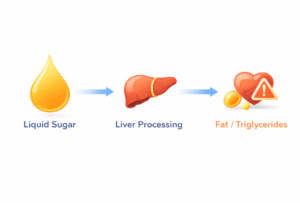
When fructose intake is high (especially in liquid form), the liver may convert more of it into
fat through de novo lipogenesis (DNL). This can contribute to higher triglyceride levels and
increased liver fat in some settings.
This matters most for people who already have:
● High triglycerides
● Insulin resistance / metabolic syndrome
● Prediabetes or diabetes
● Fatty liver risk
Juice and Uric Acid (Important for Gout Risk)
Fructose metabolism can increase uric acid production through ATP depletion and AMP
breakdown.
Clinically, uric acid rise is more likely when fructose is consumed in excess calories / high
amounts, rather than small isocaloric swaps.
So if someone has gout or high uric acid, frequent juice intake can be a hidden trigger.
Practical Takeaway
Fruit is not the enemy. Whole fruit is still a healthy choice.
But juice should be treated more like a sweet drink:
● Keep portions small
● Avoid drinking it on an empty stomach
● Prefer whole fruit most days
● Be extra cautious if you have high TG, insulin resistance, prediabetes/diabetes, fatty
liver risk, or gout
Eat your fruit. Don’t drink it daily.