
 English
 Hindi
Hindi Arabic
 Bengali
 Chinese
 French
 German
 Italian
 Japanese
 Korean
 Russian
 Spanish
 Thai
Thai Vietnamese

It’s Not Just Willpower — It’s Biology
After a long, stressful day, many people reach for something sweet, salty, or high in fat.
It’s rarely broccoli.
You might tell yourself, “I deserve this.” But stress-eating isn’t only about reward. It’s
influenced by physiology — particularly the stress hormone cortisol.
What Happens in the Body During Stress?
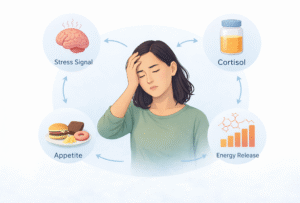
When you’re stressed, your body activates the hypothalamic–pituitary–adrenal (HPA) axis,
which increases cortisol.
Cortisol helps your body cope by mobilizing energy — including increasing glucose
availability through processes such as hepatic gluconeogenesis and reduced glucose uptake
in peripheral tissues.
In the short term, this is adaptive. But when stress becomes chronic, the same system can
start to influence appetite and behavior.
Why Stress Triggers Cravings for “Comfort Food”?
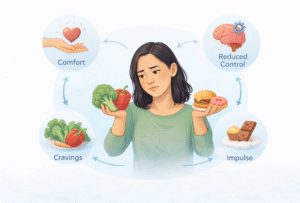
Under ongoing stress, many people experience:
● Increased appetite or stronger cravings
● A shift toward energy-dense foods (high sugar/high fat)
● Lower ability to pause and regulate impulsive choices
Highly palatable foods can feel soothing in the moment, which can reinforce a stress-relief
loop — even when it doesn’t help long-term health.
Not everyone responds the same way: some people eat more, some eat less, and some
don’t change under stress.
Stress, Cortisol, and Metabolic Health
Over time, chronic stress patterns have been associated with:
● Abdominal/visceral fat accumulation
● Higher risk of insulin resistance and metabolic imbalance
This is one reason stress management is part of modern preventive medicine — not just
mental wellness.
Breaking the Stress-Eating Cycle
The goal isn’t strict dieting. It’s reducing chronic stress load and creating structure.
Helpful strategies include:
● Regular physical activity
● Adequate sleep
● Consistent meals (so stress doesn’t stack on top of hunger)
● A brief pause before eating “automatically”
● Identifying the trigger (fatigue, conflict, overwork, lack of recovery)
When stress is better managed, cravings often become easier to handle.
It’s Not Just Discipline
If stress repeatedly drives you toward unhealthy food, it doesn’t mean you lack control. It
may mean your stress system is overactivated.
Understanding the biology helps you intervene earlier — before a short-term coping habit
becomes a long-term metabolic pattern.