
 English
 Hindi
Hindi Arabic
 Bengali
 Chinese
 French
 German
 Italian
 Japanese
 Korean
 Russian
 Spanish
 Thai
Thai Vietnamese
Not All Fats Affect Your Body the Same Way

Cooking oil is something we use almost every day — often without thinking about it.
But the type of oil you choose can influence your cholesterol levels, metabolic health,
and long-term cardiovascular risk.
Different oils contain different types of fatty acids, and each behaves differently in the
body.
Understanding Omega-3, Omega-6, and Omega-9
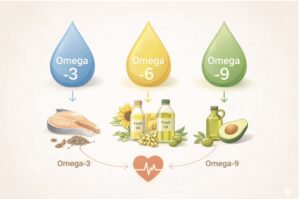
Most cooking oils contain a mix of unsaturated fats:
1. Omega-3
Found in fatty fish, flaxseed, chia seeds, and walnuts.
Omega-3 fats support cardiovascular health and play a role in regulating
inflammatory pathways. Many modern diets are relatively low in omega-3 intake.
2. Omega-6
Common in soybean, corn, sunflower, and other vegetable oils.
Omega-6 (especially linoleic acid) is an essential fatty acid — your body cannot
produce it. When omega-6 fats replace saturated fats (such as butter or palm oil),
they help lower LDL cholesterol and reduce cardiovascular risk, according to major
cardiology guidelines.
Omega-6 is not inherently “pro-inflammatory” in normal dietary amounts. The
concern is less about omega-6 itself, and more about overall dietary balance and
high intake of ultra-processed foods.
3. Omega-9 (Monounsaturated Fats)
Found in olive oil, avocado oil, and present in rice bran oil.
Omega-9 (oleic acid) is associated with improved lipid profiles and is a key
component of the Mediterranean diet, which has strong evidence for reducing
cardiovascular events.
Which Oils Should You Use?
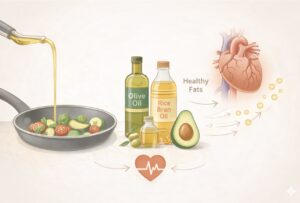
For everyday cooking, the most practical approach is to prioritize unsaturated fats
over saturated fats.
Olive Oil
- High in omega-9 (oleic acid)
- Associated with reduced cardiovascular risk
- Contains polyphenols (especially extra virgin olive oil)
- Suitable for low to moderate heat cooking
Rice Bran Oil
- Contains a mix of monounsaturated and polyunsaturated fats
- Higher smoke point, making it suitable for higher-heat cooking
- Contains compounds such as gamma-oryzanol, which may support lipid
metabolism
The key is not to eliminate all vegetable oils, but to:
- Limit saturated and trans fats
- Rotate quality oils
- Avoid repeatedly overheating oils
- Focus on the overall dietary pattern
The Bigger Picture: Oils Are Part of a Pattern
No single oil determines your health outcome.
Cardiovascular risk is influenced more by:
- Total dietary quality
- Fiber intake
- Body weight
- Physical activity
- Smoking status
- Metabolic health
Choosing better oils is helpful — but it works best alongside a balanced diet and
healthy lifestyle.